
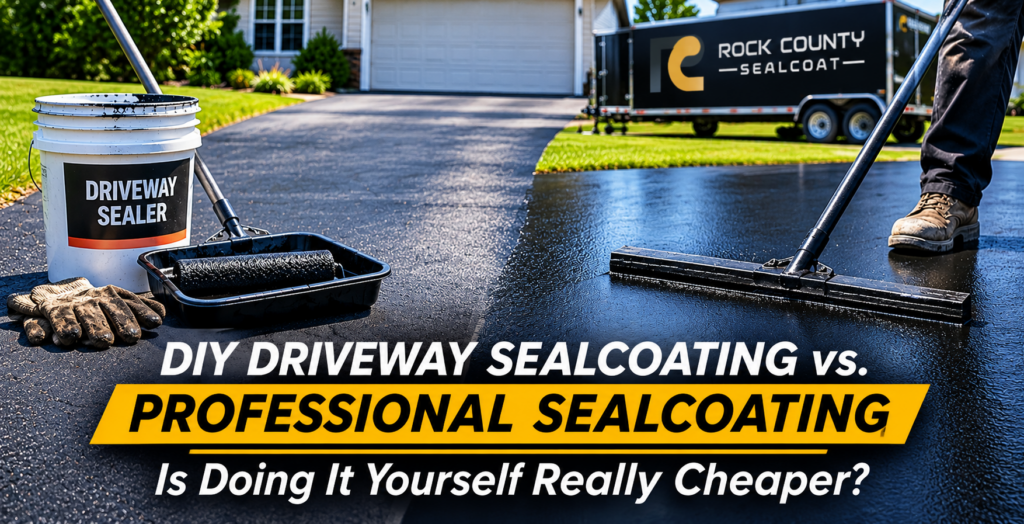
You’ve probably walked through Home Depot or Menards and seen those five-gallon buckets of driveway sealer. At first glance, it seems like an easy way to save money. Buy a few buckets, grab a roller or squeegee, and spend a Saturday sealing your driveway yourself.
But is it really that simple? And how much money are you actually saving?
The truth is, DIY driveway sealcoating can cost more than you think. By the time you purchase enough sealer to cover your driveway, buy the necessary tools, clean and prepare the asphalt, fill cracks, and spend hours applying the product, those savings can shrink pretty quickly.
There’s also something many homeowners don’t realize: Not all driveway sealers are created equal. The products sold at big-box stores can differ from the professional-grade materials used by companies like Rock County Sealcoat. Choosing the wrong product or applying it over an incompatible existing coating can lead to peeling, poor adhesion, and costly repairs.
At Rock County Sealcoat, we purchase professional-grade materials in bulk, use specialized equipment, and have experienced crews who know how to properly prepare and protect asphalt surfaces through our professional asphalt sealcoating services.
So before you load up your cart with buckets of driveway sealer, let’s compare the real costs, materials, time, and potential risks of doing it yourself versus hiring a professional. You might be surprised at how little you’re actually saving.
1. Not All Driveway Sealers Are the Same
One of the biggest differences between DIY driveway sealcoating and hiring a professional comes down to the materials being used.
Walk into Home Depot or Menards, and you’ll find several types of driveway sealers in five-gallon buckets. They may look similar, but what’s inside those buckets can vary quite a bit. The type of sealer you choose can affect how well it bonds to your asphalt, how it handles Wisconsin’s changing temperatures, and how long the finished coating lasts.
Store-Bought Driveway Sealers
Most DIY driveway sealers are designed to be easy for homeowners to apply with a brush, roller, or squeegee. Many are water-based asphalt emulsions, while others contain latex or additional polymers to improve certain performance characteristics.
These products aren’t necessarily bad. Some can provide good results when applied correctly to a driveway that’s in good condition.
However, there are a few things homeowners should understand:
- Quality varies: Not every five-gallon bucket contains the same type or quality of sealer.
- Coverage varies: Depending on the product and condition of your asphalt, you may need more buckets than expected.
- Preparation matters: Even a good product can fail if the pavement is dirty, oily, damp, or improperly prepared.
- Compatibility matters: Applying a new coating over an existing sealer without knowing what’s already there can cause adhesion problems.
That last point is especially important. If your driveway has been sealed before, you need to consider whether the new product will properly bond to the existing coating.
What About Latex-Based Driveway Sealers?
Some retail driveway sealers contain latex or other polymers that help improve flexibility, bonding, or application properties.
The problem isn’t necessarily latex itself. It’s understanding how different products work together.
For example, applying a new asphalt-based coating over an existing sealer that isn’t compatible with it could result in poor adhesion, peeling, or premature wear.
This is one reason it’s important to know what has previously been applied to your driveway before adding another coating.
A driveway that looks freshly sealed isn’t necessarily a driveway that’s properly protected.
What Does Rock County Sealcoat Use?
At Rock County Sealcoat, we use Pitch Black®, a professional-grade rubberized asphalt emulsion sealcoat.
Unlike simply choosing a bucket off the shelf, we use a product specifically selected for professional asphalt maintenance.
Pitch Black is designed to provide:
- Strong adhesion: Helps the coating bond to properly prepared asphalt.
- Flexibility: Helps the coating handle temperature changes and normal pavement movement.
- Durability: Provides a protective surface against weathering and everyday wear.
- A consistent black finish: Restores the clean, dark appearance of your driveway or parking lot.
These qualities are especially important in Southern Wisconsin, where asphalt faces hot summers, freezing winters, road salt, and repeated freeze-thaw cycles.
We also use commercial application equipment and professional preparation methods as part of our asphalt sealcoating process to help ensure the material is applied correctly.
Hot Rubberized Crack Filler vs. DIY Crack Filler
There’s another important difference that homeowners often overlook: sealcoating and crack filling are two different things.
Sealcoating protects the asphalt surface. Crack filling helps prevent water from entering cracks, where freezing and thawing can cause additional damage.
Many DIY crack fillers come in bottles, tubes, or buckets and are applied cold. These products can be useful for smaller repairs, but their performance depends on the crack, product, and application conditions.
Rock County Sealcoat provides professional asphalt crack filling using hot-pour rubberized crack sealant for appropriate repairs.
This material is heated before application and is designed to remain flexible as the pavement expands and contracts. Properly installed, it helps seal cracks against water intrusion.
One important distinction: Our Pitch Black sealcoat is not applied hot. It’s a professional asphalt emulsion coating. The hot-applied rubberized material is used for crack repairs, not for coating the entire driveway.
Why the Right Materials Matter
The goal of sealcoating isn’t simply to make your driveway look black again. It’s to help protect the asphalt underneath.
Using the wrong product, skipping proper preparation, or applying a coating over an incompatible existing sealer can lead to problems that cost more to fix later.
That’s why professional sealcoating involves more than spreading black material across your driveway. It starts with understanding the condition of the asphalt, selecting the right materials, and applying them correctly.
And when you consider that professional contractors like Rock County Sealcoat purchase materials in bulk, the difference in material costs between DIY and professional sealcoating may be smaller than you expect.
2. The Real Cost of DIY Driveway Sealcoating: Are You Actually Saving Money?
One of the biggest reasons homeowners choose to sealcoat their own driveway is to save money. And at first glance, buying a few five-gallon buckets of driveway sealer from Home Depot or Menards seems like a pretty affordable option.
But the price on the bucket doesn’t tell the whole story.
By the time you purchase enough sealer to cover your driveway, buy the necessary tools, fill cracks, and spend several hours preparing and applying everything, the savings may be smaller than you expected.
DIY vs. Professional Sealcoating: What’s Included?
Here’s a closer look at what goes into each option.
| Cost Factor | DIY Sealcoating | Rock County Sealcoat |
|---|---|---|
| Sealcoating material | Retail-priced five-gallon buckets | Professional-grade materials purchased in bulk |
| Application tools | Buy rollers, brushes, or squeegees | Commercial equipment included |
| Crack filling | Purchase separate products and tools | Professional crack filling available with your estimate |
| Surface preparation | Clean, edge, and prepare the driveway yourself | Professional surface preparation |
| Labor | Several hours of your own time | Experienced sealcoating crew |
| Cleanup | Dispose of buckets and clean tools yourself | Crew handles cleanup |
| Product selection | Research and choose the correct sealer | Materials selected based on pavement conditions |
What Does It Cost to Sealcoat a 1,000-Square-Foot Driveway Yourself?
Let’s use a typical 1,000-square-foot asphalt driveway as an example.
Depending on the retail product you choose, its coverage rate, the condition of your asphalt, and the number of coats required, you could need several five-gallon buckets of driveway sealer.
But that’s just the beginning. You’ll also need to account for:
- Driveway sealer: Enough material to cover the entire surface at the manufacturer’s recommended application rate.
- Crack filler: Additional materials if your driveway has cracks that need attention.
- Application tools: Squeegees, brushes, rollers, or other equipment.
- Cleaning supplies: Tools and materials to remove dirt, vegetation, and debris.
- Your time: Shopping, preparing the driveway, applying the sealer, and cleaning up afterward.
And don’t forget about leftover materials, empty buckets, and the mess that comes with handling driveway sealer.
Why Professional Sealcoating May Cost Less Than You Think
At Rock County Sealcoat, we purchase our sealcoating materials in bulk rather than buying individual five-gallon buckets at retail prices.
We also already have the commercial equipment, tools, and trained crews needed to complete the job.
That means you’re not paying retail prices for materials, buying tools you might only use once every few years, or giving up an entire Saturday to do the work yourself.
More importantly, you’re getting professional surface preparation and application from an experienced Southern Wisconsin asphalt maintenance company that specializes in protecting driveways and parking lots.
Don’t Forget the Cost of Doing It Twice
There’s another potential expense homeowners often overlook: What happens if the DIY sealcoating doesn’t turn out as expected?
If the surface wasn’t cleaned properly, the wrong product was used, or the new coating doesn’t bond to an existing sealer, you could end up with peeling, flaking, or uneven coverage.
Fixing those problems may require additional cleaning, surface preparation, or removal of poorly bonded material before the driveway can be sealed again.
Suddenly, that inexpensive DIY project isn’t such a bargain.
Before You Buy, Compare the Real Costs
We’re not saying DIY sealcoating never makes sense. If you have a small driveway, the right tools, and the time to do the job properly, it can be a reasonable option.
But before spending money on buckets of sealer and supplies, get a professional sealcoating estimate and compare the total costs.
You may find that having Rock County Sealcoat handle the preparation, materials, application, and cleanup costs less than you expected.
And you get your weekend back.
4. Why Professional Surface Preparation Matters
One of the biggest mistakes homeowners make when sealcoating their own driveway is rushing through the preparation.
It’s tempting to sweep off the driveway, open a bucket of sealer, and get started. But even the best driveway sealer won’t perform properly if the asphalt underneath isn’t ready for it.
Dirt, oil, loose debris, weeds, and moisture can all interfere with how well the sealer bonds to the pavement. When that happens, you may end up with peeling, uneven coverage, or areas that wear away sooner than expected.
What Goes Into Professional Driveway Preparation?
At Rock County Sealcoat, we know that a good sealcoating job starts with a properly prepared surface. Depending on the condition of your driveway, our process includes:
- Edging the driveway: Clearing grass and overgrowth along the edges so the sealer can reach the asphalt without coating your lawn.
- Removing dirt and debris: Using professional blowers and cleaning equipment to remove loose material that could interfere with adhesion.
- Removing weeds and vegetation: Clearing plants growing through cracks and along pavement edges.
- Cleaning and repairing cracks: Removing debris from cracks and applying the appropriate crack filler when repairs are needed.
- Treating oil spots: Addressing oil and automotive fluid stains that could prevent the sealcoat from bonding properly.
- Applying the sealer correctly: Using commercial spray equipment, professional squeegees, or a combination of both to achieve consistent coverage.
These steps may not be as noticeable as the fresh black finish, but they play a major role in how well the finished sealcoating performs.
Learn more about our professional asphalt sealcoating process and how proper preparation helps protect your pavement.
Why Skipping Preparation Can Cost You More
Think about painting your house. You wouldn’t expect paint to stick very well to a dirty, peeling surface. Sealcoating works much the same way.
If the asphalt isn’t properly cleaned and prepared, even a quality sealer can struggle to bond.
And once a coating starts peeling or failing, fixing the problem isn’t always as simple as applying another coat. Poorly bonded material may need to be removed before the driveway can be sealed again.
The difference between a good sealcoating job and a disappointing one often comes down to the work you don’t see.
That’s one of the biggest advantages of hiring an experienced asphalt maintenance company. At Rock County Sealcoat, surface preparation isn’t an afterthought. It’s an important part of the job.
5. DIY vs. Professional Sealcoating: Which Lasts Longer?
One of the most common questions homeowners ask is whether professional driveway sealcoating lasts longer than the products they can buy at Home Depot or Menards.
The answer depends on several factors.
A properly applied DIY product can provide good results. But professional sealcoating offers some important advantages when it comes to material selection, preparation, and consistent application.
What Determines How Long Driveway Sealcoating Lasts?
Several factors affect the life of any sealcoating application:
1. The Quality and Type of Sealer
Not all driveway sealers are made with the same ingredients or designed for the same conditions.
At Rock County Sealcoat, we use professional-grade rubberized asphalt emulsion sealcoat designed to provide strong adhesion, flexibility, and protection against everyday weathering.
Choosing a product that’s appropriate for the asphalt and any existing coating is an important part of getting good results.
2. The Condition of Your Asphalt
Sealcoating works best on asphalt that’s still in reasonably good condition.
If your driveway has extensive cracking, potholes, or areas where the asphalt is breaking apart, simply applying sealer won’t fix those underlying problems.
In some cases, professional asphalt crack filling or asphalt repairs should be completed before sealcoating. Severely deteriorated pavement may need more extensive work.
3. Proper Surface Preparation
As we covered earlier, cleaning and preparing the driveway is one of the most important steps.
Dirt, oil, moisture, and loose material can prevent even a high-quality sealer from bonding properly.
Professional preparation helps reduce these risks.
4. Application Thickness and Number of Coats
More sealer doesn’t automatically mean better protection.
Applying the material too thick can cause drying problems, cracking, or other issues. Applying too little may leave areas with inadequate coverage.
Different products have specific application requirements, and some surfaces benefit from multiple coats.
Professional crews understand how to apply materials at the proper coverage rate based on the product and pavement conditions.
5. Weather During Application
Wisconsin weather can make sealcoating tricky.
Temperature, humidity, rain, and sunlight all affect how sealcoating materials dry and cure.
Applying sealer when conditions aren’t right can lead to poor adhesion, slow drying, or premature failure.
An experienced contractor knows when conditions are suitable for application and when it’s better to wait.
6. Traffic and Ongoing Maintenance
A residential driveway with a couple of vehicles experiences different wear than a busy commercial parking lot.
Vehicle traffic, turning tires, snowplows, road salt, oil leaks, and standing water can all affect how long a sealcoating application performs.
Regular inspections and timely crack repairs can help protect your pavement between sealcoating applications.
Does Professional Sealcoating Really Last Longer?
Professional sealcoating isn’t a guarantee that your driveway will last a specific number of years longer than a DIY application.
However, using the right materials, properly preparing the surface, and applying the coating under the right conditions can improve the chances of getting a longer-lasting, more consistent result.
That’s where experience makes a difference.
At Rock County Sealcoat, we work with asphalt driveways and parking lots throughout Southern Wisconsin. We understand the challenges created by our changing seasons and how important it is to select the right maintenance approach for each property.
The Real Goal Is Protecting Your Asphalt
It’s easy to focus on how black and shiny your driveway looks immediately after sealcoating.
But appearance is only part of the equation.
The real goal is to help protect your asphalt from weathering, moisture, sunlight, and everyday wear so you can get more life out of your pavement.
Whether you choose DIY or professional sealcoating, doing the job correctly matters far more than simply getting a fresh coat of black material on the driveway.
And when you consider the cost of replacing an asphalt driveway, proper maintenance is an investment worth taking seriously.
6. Why Wisconsin Weather Makes the Right Driveway Sealer Important
If you live in Southern Wisconsin, you already know our weather can be tough on just about everything outdoors. Your asphalt driveway or parking lot is no exception.
From freezing winters and heavy snow to hot summer days, Wisconsin pavement takes a beating throughout the year. That’s why choosing the right driveway sealer and applying it correctly is especially important in communities like Janesville, Beloit, Milton, Madison, and the surrounding areas.
Freeze-Thaw Cycles Can Cause Serious Asphalt Damage
One of the biggest threats to asphalt in Wisconsin is the constant freezing and thawing that happens during fall, winter, and early spring.
Here’s what happens:
- Water enters small cracks in your driveway.
- Temperatures drop below freezing, causing that water to expand.
- The expansion can put pressure on the surrounding asphalt.
- As temperatures warm up, the ice melts and water can move deeper into the pavement.
- Repeated freezing and thawing can make existing cracks worse and contribute to potholes and other damage.
This is why proper crack filling is just as important as sealcoating.
At Rock County Sealcoat, we use professional hot-pour rubberized crack sealant for appropriate repairs. The material is designed to remain flexible as pavement expands and contracts with changing temperatures.
Sealcoating then helps protect the asphalt surface from moisture and weathering.
Road Salt, Snowplows, and Winter Wear
Wisconsin winters bring more than freezing temperatures. Road salt, snow removal equipment, and repeated exposure to ice and moisture can also take a toll on your driveway.
Snowplow blades can scrape the pavement, especially around raised cracks and uneven areas. Deicing chemicals and moisture can contribute to pavement deterioration, particularly where asphalt is already damaged.
Sealcoating helps protect the asphalt surface from everyday exposure, but it won’t prevent damage from a plow blade or repair existing structural problems.
That’s why keeping cracks repaired and maintaining the pavement before winter can make a difference.
Summer Heat Creates Different Challenges
While winter gets most of the attention, Wisconsin summers can also be hard on asphalt.
Hot temperatures, direct sunlight, and UV exposure gradually contribute to asphalt oxidation. Over time, the pavement can fade from black to gray and become more brittle.
As asphalt loses flexibility, it can become more vulnerable to cracking and surface deterioration.
Professional asphalt sealcoating helps slow surface oxidation and provides a protective barrier against weathering.
At Rock County Sealcoat, we use Pitch Black®, a professional rubberized asphalt emulsion sealcoat selected for its adhesion, flexibility, and durability.
Why Flexibility and Adhesion Matter
With Wisconsin’s temperature swings, you want a sealcoating product that bonds properly to the asphalt and can handle normal changes in pavement temperature.
But the product alone isn’t enough.
Even a quality sealer can fail if it’s applied over dirt, oil, moisture, or an incompatible existing coating.
Proper surface preparation, crack repair, application thickness, and weather conditions all play a role in how well the finished coating performs.
This is where working with an experienced local asphalt maintenance company can make a difference.
Timing Matters: When Should You Sealcoat in Wisconsin?
Sealcoating needs the right weather conditions to dry and cure properly.
Applying sealer when temperatures are too low, rain is approaching, or the pavement is still wet can affect adhesion and the finished result.
Different products have specific temperature and drying requirements, so it’s important to follow the manufacturer’s recommendations rather than simply picking a sunny afternoon.
At Rock County Sealcoat, we monitor weather conditions and schedule projects when conditions are appropriate for the materials we’re using.
Protecting Driveways and Parking Lots Across Southern Wisconsin
Whether you own a residential driveway in Janesville, manage a commercial parking lot in Beloit, or maintain a property in the Madison area, Wisconsin weather creates many of the same asphalt maintenance challenges.
The goal isn’t just to make your pavement look new for a few months. It’s to help protect your investment through years of changing seasons.
Choosing the right materials, repairing cracks properly, and applying sealcoat under the right conditions can help your asphalt stand up to Wisconsin weather.
Learn more about our asphalt sealcoating services in Southern Wisconsin and how we help homeowners and businesses maintain their pavement.
And that’s one more reason to consider professional sealcoating instead of simply grabbing the cheapest bucket off the shelf.
7. When Does DIY Sealcoating Make Sense?
We’ve covered quite a few reasons why professional driveway sealcoating can be a better investment, but that doesn’t mean doing it yourself is always a bad idea.
There are situations where DIY sealcoating makes sense, especially if you enjoy working on home improvement projects and have the time to do the job correctly.
When DIY Driveway Sealcoating Might Be a Good Option
Doing the work yourself may be worth considering if:
- You have a small driveway. A smaller surface requires less material and can be easier to manage without professional equipment.
- Your asphalt is in good condition. If your driveway has very few cracks, no major damage, and doesn’t need extensive preparation, the job will be more manageable.
- You know what product to use. You’ve researched the sealer, understand its application requirements, and know it’s compatible with any existing coating.
- You already have the tools. If you own the necessary cleaning and application equipment, you can avoid some additional expenses.
- You have the time and don’t mind the work. Some homeowners enjoy tackling projects themselves, even when the savings aren’t significant.
If these conditions apply, a quality store-bought driveway sealer that’s properly applied can provide reasonable results.
When Hiring a Professional Makes More Sense
There are also situations where professional sealcoating is likely the smarter choice.
Larger Driveways
The bigger your driveway, the more buckets of sealer you’ll need to purchase, transport, and apply. Larger surfaces also make it more difficult to maintain consistent coverage before the material begins drying.
Professional equipment and experienced crews can make a significant difference on larger projects.
Driveways With Cracks or Existing Coatings
If your driveway has significant cracking, oil stains, surface damage, or several layers of old sealer, there’s more to consider than simply applying another coat.
Using the wrong material or applying new sealer over an incompatible existing coating can create adhesion problems.
A professional can evaluate the pavement and recommend the appropriate preparation, repairs, and materials.
Commercial Parking Lots
For most commercial parking lots, DIY sealcoating simply isn’t practical.
Larger surfaces require more materials, specialized equipment, and careful planning. Property owners also need to consider vehicle traffic, customer access, parking restrictions, and scheduling.
Rock County Sealcoat works with commercial property owners and managers throughout Southern Wisconsin. Our RCS 2.0 technology helps coordinate scheduling, track crews, and keep customers informed throughout their projects.
Homeowners Who Want to Save Time and Avoid the Mess
Even if your driveway is in good condition, you may decide that spending your weekend cleaning asphalt, hauling buckets, and spreading sealer isn’t worth the potential savings.
Hiring a professional means you don’t have to purchase equipment, handle messy materials, or worry about getting black sealer on your garage floor, sidewalks, or landscaping.
Our Advice: Get an Estimate Before You Decide
At Rock County Sealcoat, we understand why homeowners consider doing their own sealcoating. Everyone wants to save money, and there’s nothing wrong with taking care of your own property.
But before you head to Home Depot or Menards, we recommend finding out what professional sealcoating would actually cost.
Because we purchase materials in bulk, use commercial equipment, and have experienced crews, the difference between doing it yourself and hiring a professional may be smaller than you think.
At the very least, getting an estimate gives you a real number to compare against the cost of DIY materials, tools, and your time.
Then you can decide which option makes the most sense for your driveway, your budget, and your weekend.
8. Before You Buy Those Buckets, Get a Professional Sealcoating Estimate
Before you load up your cart at Home Depot or Menards with driveway sealer, rollers, brushes, and other supplies, take a few minutes to find out what professional sealcoating would actually cost.
You might be surprised.
At Rock County Sealcoat, we purchase professional-grade sealcoating materials in bulk, use specialized equipment, and have experienced crews who know how to properly prepare and protect your asphalt.
That means you don’t have to spend your weekend hauling heavy buckets, cleaning cracks, spreading messy sealer, or worrying about whether you chose the right product.
And when you add up the cost of DIY materials, tools, and your time, the savings from doing it yourself might not be nearly as much as you expected.
We’re not saying you can’t sealcoat your own driveway. We’re simply suggesting you compare the real costs before making that decision.
Rock County Sealcoat serves homeowners and businesses throughout Janesville, Beloit, Milton, Madison, and surrounding Southern Wisconsin communities.
Why spend your weekend doing the dirty work if you don’t have to?
Get a Free Driveway or Parking Lot Sealcoating Estimate
Whether you’re maintaining a residential driveway or a commercial parking lot, our team can evaluate your asphalt and recommend the right maintenance approach.
Request your free, no-obligation sealcoating estimate today. Find out how affordable professional asphalt maintenance can be before you spend money doing it yourself.
Frequently Asked Questions About DIY vs. Professional Driveway Sealcoating
1. Is it cheaper to sealcoat your own driveway?
DIY driveway sealcoating can be cheaper upfront, but the savings may be smaller than you think. You’ll need to purchase sealer, application tools, crack filler, and cleaning supplies. You’ll also spend time preparing and coating the driveway. Professional companies like Rock County Sealcoat purchase materials in bulk and already have the necessary equipment, making professional sealcoating worth comparing before you buy.
2. Is Home Depot driveway sealer as good as professional sealcoat?
Some driveway sealers sold at Home Depot and Menards can provide good results when applied correctly. However, retail products vary in quality, ingredients, coverage, and durability. Rock County Sealcoat uses professional-grade rubberized asphalt emulsion sealcoat designed for strong adhesion and flexibility. Proper surface preparation and application are just as important as the product itself.
3. Can you put professional asphalt sealer over latex driveway sealer?
Sometimes, but it depends on the specific products and condition of the existing coating. Not all driveway sealers are compatible, and applying a new coating over an unsuitable or poorly bonded surface can cause peeling or adhesion problems. Before applying professional sealcoat over an existing latex-based product, the surface and product compatibility should be evaluated.
4. Why does driveway sealer peel or flake off?
Driveway sealer can peel or flake because of poor surface preparation, moisture, oil contamination, incompatible coatings, or improper application. Applying sealer too thick or during unsuitable weather can also cause problems. Cleaning the asphalt thoroughly, choosing the right product, and following proper application procedures help reduce the risk of premature coating failure.
5. What is the difference between hot rubberized crack filler and regular driveway crack filler?
Many DIY driveway crack fillers are applied cold directly from a bottle, tube, or bucket. Professional hot-pour rubberized crack sealant is heated before application and designed to remain flexible as pavement expands and contracts. Rock County Sealcoat uses hot-pour rubberized crack sealant for appropriate repairs to help prevent water from entering cracks, especially during Wisconsin’s freeze-thaw cycles.
6. How many five-gallon buckets of sealer do I need for a driveway?
The number of five-gallon buckets depends on your driveway’s square footage, surface condition, product coverage rate, and number of coats. For example, a 1,000-square-foot driveway would require five buckets if the product covers 200 square feet per bucket at the recommended application rate. Always check the manufacturer’s coverage instructions before purchasing materials.
7. How long does DIY driveway sealer last compared to professional sealcoating?
There’s no guaranteed lifespan difference between DIY and professional sealcoating. Durability depends on the sealer used, asphalt condition, surface preparation, application, weather, and vehicle traffic. Professional sealcoating offers advantages in material selection, equipment, and application experience, which can help produce more consistent results and reduce the risk of premature failure.
8. Is it worth hiring someone to sealcoat a driveway?
For many homeowners, hiring a professional is worth considering. Professional sealcoating eliminates the need to purchase tools, transport heavy buckets, prepare the surface, and apply messy materials yourself. Companies like Rock County Sealcoat also have experience selecting appropriate products and repairing cracks. Getting an estimate allows you to compare the total cost against doing the work yourself.
9. Can you sealcoat a parking lot yourself?
It’s possible to sealcoat a small parking area yourself, but larger commercial parking lots are generally better suited for professional crews. Commercial projects require significant amounts of material, specialized equipment, surface preparation, and careful traffic management. Rock County Sealcoat provides commercial parking lot sealcoating throughout Southern Wisconsin, helping property owners coordinate maintenance while minimizing disruption to customers and employees.
10. How often should asphalt driveways be sealcoated in Wisconsin?
Many asphalt driveways benefit from sealcoating approximately every two to three years, but the right schedule depends on pavement condition, traffic, weather exposure, and the products previously applied. Wisconsin’s freeze-thaw cycles, road salt, and summer heat can contribute to asphalt deterioration. Rock County Sealcoat recommends evaluating your driveway’s condition rather than automatically applying another coat on a fixed schedule.
Recent Comments